
2026 Regional Fall Foliage Forecast: October 13
Fall color is finally gaining momentum across the North Carolina mountains, and the 2026 foliage season is beginning to show some encouraging signs of progress.
After holding every category steady last week because of the slower-than-expected transition, I'm making one adjustment to this week's Rowan County Weather Regional Fall Foliage Forecast.
The higher elevations are displaying increasingly noticeable reds, oranges, and yellows, particularly along portions of the Blue Ridge Parkway. However, the transition remains uneven, with some locations showing impressive color while others remain surprisingly green.
And for the first time this season, I'm introducing Early Change into the Triad and Northwest Piedmont.
That doesn't mean widespread fall color has arrived across our region, but it does suggest the seasonal transition is beginning to work its way eastward.
October 13 Regional Outlook
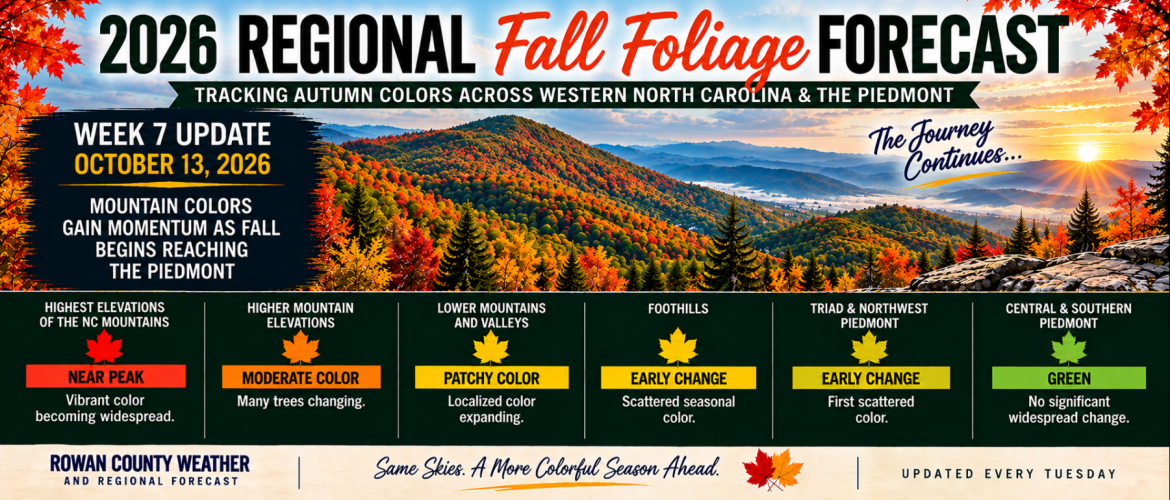
Highest Elevations of the NC Mountains: NEAR PEAK - Vibrant Color Becoming Widespread
Higher Mountain Elevations: MODERATE COLOR - Many Trees Changing
Lower Mountains and Valleys: PATCHY COLOR - Localized Color Expanding
Foothills: EARLY CHANGE - Scattered Seasonal Color
Triad and Northwest Piedmont: EARLY CHANGE - First Scattered Color
Central and Southern Piedmont: GREEN - No Significant Widespread Change
Five of our six regional categories remain unchanged this week, but that doesn't mean the foliage season has stopped progressing.
The changes taking place within those categories are becoming increasingly noticeable.
Mountain Color Is Gaining Momentum
The highest elevations of the North Carolina mountains continue to offer some of the best opportunities for significant fall color.
Recent observations from portions of the Blue Ridge Parkway, including areas around Graveyard Fields, Rough Ridge, and Grandfather Mountain, indicate that color is becoming more established.
Reds, oranges, and yellows are increasingly visible, although the intensity varies considerably from one location to another.
Some individual trees and shrubs are already displaying near-peak or peak color, while nearby slopes remain a mixture of green and changing foliage.
For that reason, I'm keeping the highest elevations at NEAR PEAK rather than advancing the entire category to PEAK.
It's important to remember that these regional classifications represent broad areas, not individual overlooks or mountain peaks.
Some locations may already be experiencing their best color of the season, while others still have additional changes ahead.
Higher Mountain Elevations Remain at Moderate Color
The higher mountain elevations remain at MODERATE COLOR.
More trees are changing, and the fall landscape is becoming increasingly colorful.
However, the transition hasn't been consistent across the region.
Elevation, tree species, rainfall, and exposure to sunlight all influence when and how individual trees change.
The warmer-than-normal conditions experienced earlier this fall have also contributed to the slower progression.
While the higher mountains are becoming increasingly attractive for fall foliage viewing, I'm not ready to classify the entire region as Near Peak.
That could change over the next week.
Lower Mountains and Valleys Continue to Develop Patchy Color
The lower mountains and valleys remain at PATCHY COLOR.
Scattered areas of yellow, orange, and red are becoming easier to find, but green continues to dominate much of the landscape.
This is an important part of the seasonal progression.
Fall color typically develops first at the highest elevations before gradually moving down the mountainsides into lower elevations and valleys.
The transition isn't always smooth, and this year's uneven weather conditions have made those differences especially noticeable.
I expect the lower mountains and valleys to become more colorful as we move deeper into October.
Foothills Remain in Early Change
The foothills remain at EARLY CHANGE.
Individual trees are beginning to display seasonal color, but widespread changes have not developed.
For most locations, the landscape remains predominantly green.
However, the foothills are now entering the portion of October when more noticeable changes should begin developing.
The next seven to fourteen days will be important in determining how quickly color expands into these areas.
Early Change Arrives in the Triad and Northwest Piedmont
This is the biggest adjustment in this week's forecast.
I'm advancing the Triad and Northwest Piedmont from GREEN to EARLY CHANGE.
That doesn't mean widespread fall color has arrived.
Instead, I'm anticipating that scattered trees will begin displaying more noticeable seasonal color during the coming week.
Some locations may already have individual trees showing yellows, oranges, or reds, while others remain completely green.
This is still the beginning of the transition, and the overall landscape should remain predominantly green.
The distinction is important because early color on individual trees doesn't necessarily indicate that the entire region is experiencing significant foliage changes.
Nevertheless, it's another sign that the 2026 fall foliage season is gradually progressing eastward.
Rowan, Davie, Davidson, and Cabarrus Counties Remain Predominantly Green
For the central and southern Piedmont, including Rowan, Davie, Davidson, and Cabarrus counties, I'm maintaining GREEN - No Significant Widespread Change.
You may have noticed some trees beginning to change color in your neighborhood.
Others may be dropping leaves or developing brown patches.
But across the broader region, widespread seasonal color has not arrived.
There may be localized differences, particularly in northern portions of Davie and Davidson counties, where scattered seasonal color could become more noticeable before areas farther south.
However, those isolated changes aren't enough to advance the entire central Piedmont category.
Late October into early November remains the period I'm watching for the most significant foliage changes across our area.
Drought and Warm Temperatures Continue to Influence the Season
The weather leading into autumn continues to play an important role in the 2026 foliage season.
Warm September temperatures likely contributed to the slower development of fall color in many locations.
Meanwhile, drought conditions have affected portions of North Carolina throughout the growing season.
Drought stress can cause leaves to turn brown, lose their vibrancy, or fall prematurely.
That can create a patchwork appearance across the landscape, with some trees displaying attractive fall color while others transition less dramatically.
It also means that not every tree changing color is necessarily responding to the normal seasonal process.
As I continue evaluating the foliage progression, I'm looking for widespread seasonal color rather than simply counting trees that have begun dropping leaves.
What's Changed Since Last Week?
Last week's forecast held every category steady because observations suggested the foliage transition was progressing more slowly than anticipated.
This week, I'm making one adjustment.
Highest Elevations: NEAR PEAK to NEAR PEAK
Higher Mountain Elevations: MODERATE COLOR to MODERATE COLOR
Lower Mountains and Valleys: PATCHY COLOR to PATCHY COLOR
Foothills: EARLY CHANGE to EARLY CHANGE
Triad and Northwest Piedmont: GREEN to EARLY CHANGE
Central and Southern Piedmont: GREEN to GREEN
Although only one category has changed, color continues developing within the mountain regions.
The difference between last week and this week should become increasingly apparent in some of the higher elevations.
What I'm Watching Over the Next Seven Days
The coming week could bring some of the more significant changes we've seen so far this season.
I'm watching for the possibility of peak color becoming more widespread across the highest elevations.
The higher mountains could begin approaching Near Peak, while the lower mountains and valleys may experience a more noticeable expansion of color.
The foothills should continue their gradual transition, and scattered seasonal color may become easier to find across the Triad and Northwest Piedmont.
For Rowan, Davie, Davidson, and Cabarrus counties, widespread color remains farther down the road.
The most significant changes across our immediate region should develop later in October and potentially into early November.
As always, these are expectations rather than guarantees. Weather conditions and actual observations will determine when each region advances to the next category.
October 13 Fall Foliage Forecast
Highest Elevations of the NC Mountains: NEAR PEAK - Vibrant Color Becoming Widespread
Higher Mountain Elevations: MODERATE COLOR - Many Trees Changing
Lower Mountains and Valleys: PATCHY COLOR - Localized Color Expanding
Foothills: EARLY CHANGE - Scattered Seasonal Color
Triad and Northwest Piedmont: EARLY CHANGE - First Scattered Color
Central and Southern Piedmont: GREEN - No Significant Widespread Change
Seven weeks into the 2026 fall foliage season, the mountains are becoming increasingly colorful, and the first signs of seasonal change are beginning to spread farther east.
The progression has been slower and more uneven than initially anticipated, but autumn color is continuing its journey across North Carolina.
For those hoping to see fall color in the mountains, the opportunities are improving.
For those of us in the Piedmont, patience is still the name of the game.
The best part of our foliage season is still ahead.
Next Update: Tuesday, October 20, 2026.