
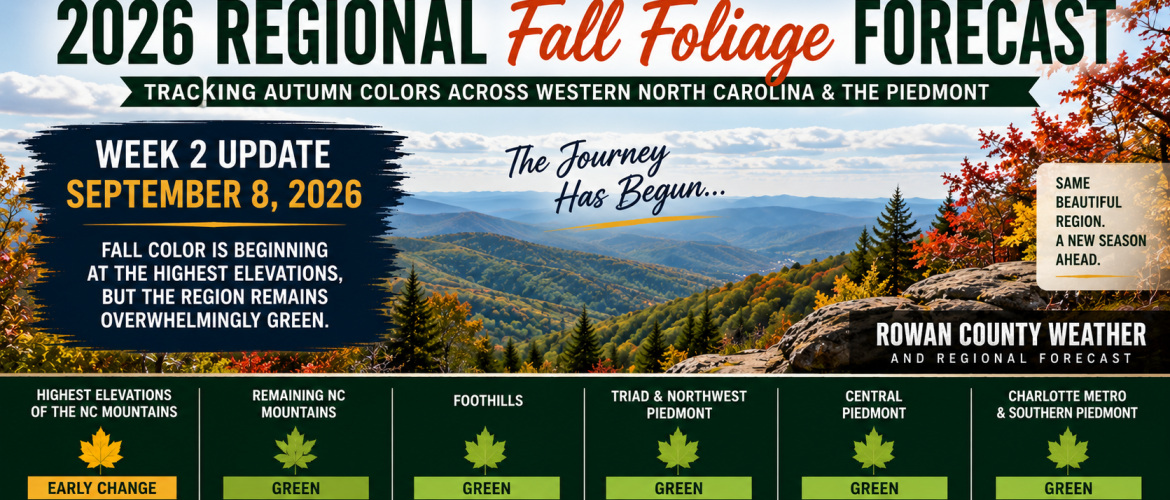
2026 Regional Fall Foliage Forecast: September 8
One week into September, the 2026 fall foliage season remains overwhelmingly green across North Carolina, but we're getting closer to the point where the first subtle signs of autumn should begin appearing in the highest elevations.
For this week's Rowan County Weather Regional Fall Foliage Forecast, I'm introducing our first area of EARLY CHANGE at the highest elevations of the North Carolina mountains.
This does not mean widespread fall color has arrived. Far from it.
Most mountain slopes remain green, and the foothills and Piedmont remain solidly in the GREEN category. But as we approach the middle of September, the highest peaks are entering the period when isolated trees and early-changing species can begin showing the first hints of the season.
September 8 Regional Outlook
Highest Mountain Elevations: EARLY CHANGE — Just Starting
Most of the Western North Carolina Mountains: GREEN — No Significant Change
Foothills: GREEN — No Significant Change
Triad and Northwest Piedmont: GREEN — No Significant Change
Central Piedmont: GREEN — No Significant Change
Charlotte Metro and Southern Piedmont: GREEN — No Significant Change
The big takeaway this week is that the transition is just beginning at the very top of the mountains, while almost everyone else still has plenty of waiting to do.
Highest Elevations: The First Change Begins
This is the first week I'm moving any portion of the regional forecast out of the GREEN category.
The change is limited to the highest elevations of western North Carolina, where the first isolated hints of yellow, gold or red should begin becoming possible as we move toward the middle of September.
The Great Smoky Mountains National Park notes that color changes can begin as early as mid-September at the highest elevations. Yellow birch, American beech, mountain maple, hobblebush and pin cherry are among the species that can begin changing first.
That doesn't mean entire mountainsides are changing color.
Think scattered trees and subtle hints rather than sweeping autumn landscapes.
For this week, those highest elevations move into:
EARLY CHANGE — Just Starting
Most of the North Carolina Mountains Remain Green
Drop even a little in elevation and the story remains much the same as last week.
The Blue Ridge Mountains are still predominantly green. A report from western North Carolina late last week described the mountains as still wearing their summer green, with the fall color season remaining several weeks away.
That's consistent with the typical progression.
The Blue Ridge Parkway notes that scattered trees at higher elevations sometimes begin developing color in late September, while the majority of trees typically change during October.
For most mountain elevations:
GREEN — No Significant Change
Foothills Remain Green
There is no reason to advance the foothills this week.
The canopy remains overwhelmingly green, and widespread seasonal change remains several weeks away.
Once color becomes established across the higher mountains, we'll begin watching for it to work downhill into the valleys and eventually toward the foothills.
For September 8:
GREEN — No Significant Change
Piedmont Remains Green
Across Rowan, Davie, Davidson, Cabarrus and the surrounding Piedmont, we're still firmly in summer-green territory.
The Salisbury area, Charlotte region and Triad remain well behind the mountains in the seasonal progression.
That is normal.
Elevation is one of the biggest reasons North Carolina enjoys such a long fall foliage season. Color generally begins at the highest elevations before gradually moving down the mountains and eventually into the Piedmont.
For the Piedmont:
GREEN — No Significant Change
Drought Is Still Worth Watching
Drought remains one of the more interesting variables heading into the 2026 foliage season.
The North Carolina Drought Management Advisory Council's September 1 update continued to show drought or abnormally dry conditions across portions of the state. Rowan County was classified as abnormally dry in that update.
That doesn't necessarily mean poor fall color.
But drought-stressed trees can sometimes brown or shed leaves prematurely, which is why it's important to distinguish stress-related changes from the genuine autumn transition.
I'll continue watching rainfall trends throughout September.
September Weather Becomes Increasingly Important
We're now entering a more important stretch for determining how the foliage season develops.
The North Carolina State Climate Office's September outlook called for a hot and dry beginning to the month, with greater uncertainty in the overall weather pattern toward mid-September.
Cool nights combined with bright, sunny days are among the best ingredients for vibrant fall color. Adequate rainfall can also help leaves remain on trees longer. Conversely, warm, cloudy and wet conditions can mute the display.
The weather over the next two to three weeks will therefore tell us much more about the direction of the 2026 season.
What's Changed Since Last Week?
Last week, the entire regional forecast was GREEN.
This week:
The highest elevations move from GREEN to EARLY CHANGE.
Everywhere else remains GREEN.
It's a small change on the map, but it's the first step in a process we'll follow for the next couple of months.
September 8 Fall Foliage Forecast
Highest elevations of the NC Mountains: EARLY CHANGE — Just Starting
Remaining NC Mountains: GREEN — No Significant Change
Foothills: GREEN — No Significant Change
Triad and Northwest Piedmont: GREEN — No Significant Change
Central Piedmont: GREEN — No Significant Change
Charlotte Metro and Southern Piedmont: GREEN — No Significant Change