
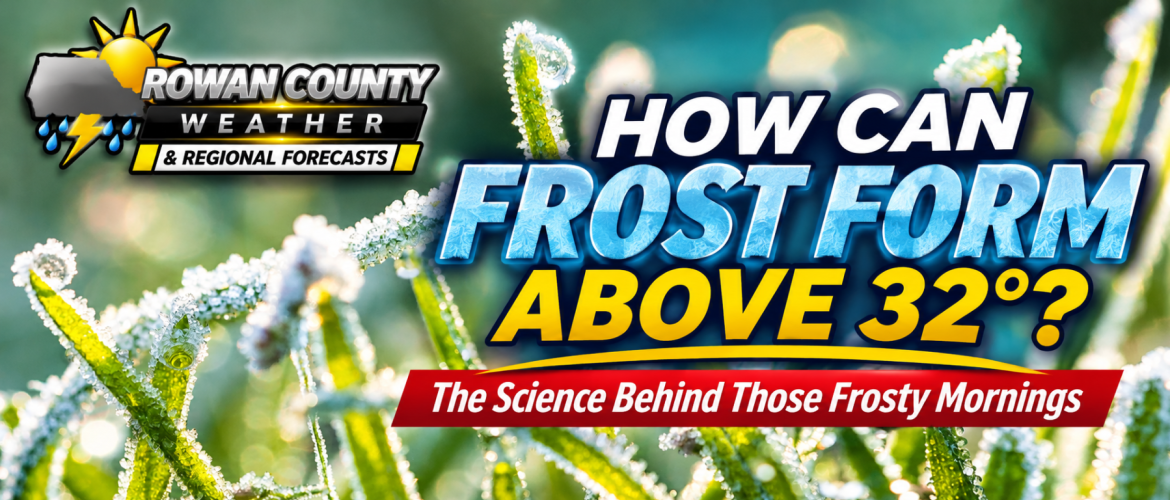
Weather 101: How Can Frost Form When Temperatures Are Above Freezing?
Saturday, November 7, 2026 | Rowan County Weather & Regional Forecast
Have you ever checked the forecast before going to bed, noticed the overnight low was supposed to be 36 degrees, and then awakened to find frost covering your lawn or car windshield?
You might wonder how that's possible. After all, doesn't water freeze at 32 degrees?
The answer involves one of the more interesting processes in meteorology: radiational cooling.
And with chilly temperatures expected across Rowan, Davie, Davidson, and Cabarrus counties tonight, this is a perfect opportunity to explain how frost can develop even when the official forecast never reaches freezing.
The Temperature You See Isn't Necessarily the Temperature at the Ground
Here's something many people don't realize.
Official weather observations are generally taken about five to six feet above the ground.
That means when a forecast calls for an overnight low of 36 degrees, it describes the expected air temperature at approximately that height.
But grass, rooftops, vehicle windshields, and other exposed surfaces can become considerably colder.
Under the right conditions, the air temperature might be 36 degrees while the temperature of your grass or windshield falls to 32 degrees or below.
That's cold enough for frost to form.
Why Does the Ground Get Colder?
During the day, sunlight warms the Earth's surface.
After sunset, the ground begins losing energy through infrared radiation. Meteorologists call this radiational cooling.
When skies are clear, that heat can escape more efficiently.
When winds are light, the colder air near the surface isn't mixed as effectively with warmer air above it.
The result can be a shallow layer of particularly cold air near the ground.
In some situations, surface temperatures can be five to ten degrees colder than the air measured several feet above the ground.
This explains why you might find frost on your lawn even though your backyard thermometer reads 35 or 36 degrees.
The Three Ingredients That Favor Frost
Several atmospheric conditions can increase the likelihood of frost developing.
1. Clear Skies
Clouds can act like a blanket by absorbing and emitting infrared radiation. When skies are clear, exposed surfaces generally lose heat more efficiently.
2. Light Winds
Calm or nearly calm conditions allow colder air to collect near the surface. Stronger winds mix the atmosphere, making it harder for the ground to become substantially colder than the air above it.
3. Sufficient Moisture
Frost requires moisture. Water vapor can deposit directly as ice crystals onto a below-freezing surface, or liquid dew can freeze as the surface cools.
Very dry air can limit frost formation even when temperatures become cold enough.
Why Some Neighborhoods Get Frost and Others Don't
Have you ever noticed frost in a rural field while nearby neighborhoods remain frost-free?
Local geography plays an important role.
Cold, dense air tends to collect in low-lying areas, valleys, and sheltered locations.
Open fields can also experience substantial nighttime cooling.
Meanwhile, developed areas may remain slightly warmer because roads, buildings, and other surfaces release heat accumulated during the day.
That's why one neighborhood in Rowan County might experience frost while another location just a few miles away does not.
Frost Versus a Freeze: What's the Difference?
Although the terms are often used together, frost and freezing temperatures aren't exactly the same thing.
Frost: Ice crystals form on surfaces that have cooled to freezing or below. This can happen even when the measured air temperature remains above 32 degrees.
Freeze: The air temperature itself reaches 32 degrees or lower.
It's possible to have frost without an official freeze, and freezing temperatures without visible frost.
Both can affect sensitive vegetation, depending on the temperature, duration, and plant type.
What Does This Mean for Tonight?
Our Saturday night forecast calls for temperatures generally in the middle to upper 30s across Rowan, Davie, Davidson, and Cabarrus counties.
Colder rural and sheltered locations could experience patchy frost if skies clear sufficiently and winds become light.
Not every location will see frost, and widespread freezing temperatures are not currently expected based on our published county forecasts.
However, residents with particularly sensitive plants may want to take precautions.
How to Protect Sensitive Plants
If you're concerned about frost tonight, there are a few simple steps you can take.
-
Bring potted plants indoors or into a protected location.
-
Cover sensitive outdoor plants with frost cloth or lightweight fabric.
-
Secure coverings so they extend toward the ground and help retain warmth.
-
Remove coverings when temperatures warm the following morning.
-
Pay particular attention to gardens in low-lying or sheltered locations.
Remember that frost can develop even when your weather app shows temperatures a few degrees above freezing.
The Bottom Line
A forecast low of 36 degrees doesn't guarantee that everything outdoors will remain above freezing.
The temperature of grass, plants, windshields, and other exposed surfaces can be lower than the official air temperature.
Clear skies, light winds, sufficient moisture, and local geography all influence whether frost develops.
So the next time you wake up to frost despite an above-freezing forecast, remember: the forecast temperature and the surface temperature are not necessarily the same.
That's another example of why understanding the science behind the forecast can be just as important as knowing the numbers.
Rowan County Weather & Regional Forecast — Helping You Understand the Weather, One Forecast at a Time.