
2026 Regional Fall Foliage Forecast: September 15
The first signs of autumn are becoming a little easier to find in the North Carolina mountains.
For the September 15 Rowan County Weather Regional Fall Foliage Forecast, I'm advancing the highest elevations into PATCHY COLOR, while EARLY CHANGE begins expanding into some of the surrounding higher mountain elevations.
For the foothills and Piedmont, however, summer green continues to dominate.
We're still a long way from peak color, but the 2026 transition is officially underway.
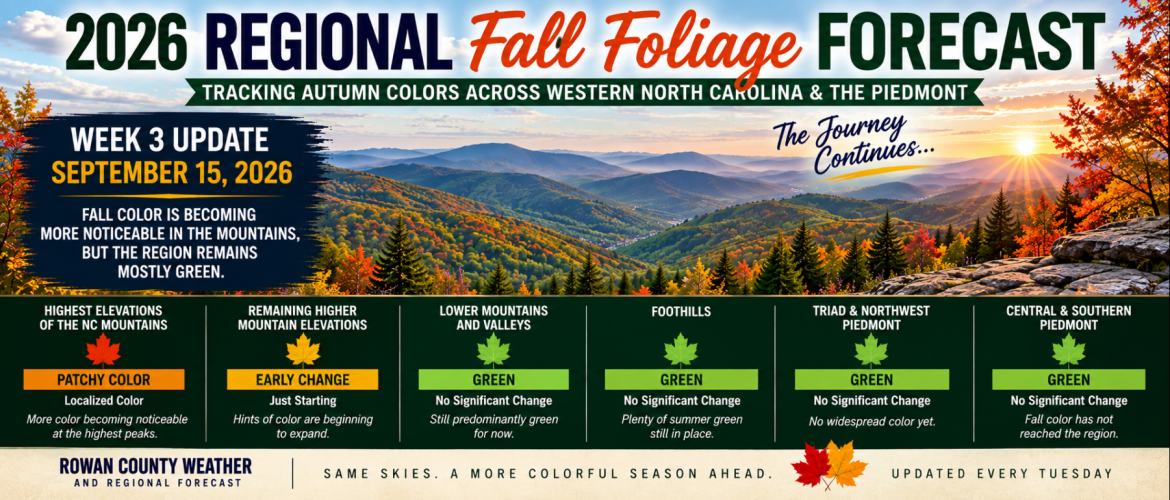
September 15 Regional Outlook
Highest Elevations of the NC Mountains: PATCHY COLOR — Localized Color
Remaining Higher Mountain Elevations: EARLY CHANGE — Just Starting
Lower Mountains and Valleys: GREEN — No Significant Change
Foothills: GREEN — No Significant Change
Triad and Northwest Piedmont: GREEN — No Significant Change
Central and Southern Piedmont: GREEN — No Significant Change
The most important change this week is at elevation. That's where the first genuine signs of the autumn transition are becoming noticeable.
Patchy Color Develops at the Highest Elevations
Last week, I introduced EARLY CHANGE at the highest elevations.
This week, those areas take another step forward.
Reports from western North Carolina indicate early signs of fall color are emerging at higher elevations, with species including dogwoods, red maples and yellowwoods beginning to show changes.
That doesn't mean we're seeing entire mountainsides covered in brilliant reds, oranges and yellows.
We're not.
Instead, think of individual trees and pockets of color mixed into a landscape that remains predominantly green.
That's exactly what the PATCHY COLOR category is intended to represent.
Early Change Expands Through the Higher Mountains
Below the highest peaks, I'm introducing more EARLY CHANGE this week.
The transition remains subtle, and green continues to dominate most views. But as we move through the second half of September, increasingly noticeable hints of color should begin developing at higher elevations.
The Blue Ridge Parkway notes that scattered trees at higher elevations can begin developing fall color in late September, while the majority of trees typically make their transition during October.
We're approaching that window now.
Lower Mountains and Foothills Remain Green
Drop farther in elevation and there isn't enough evidence yet to move these areas into a new category.
The lower mountain valleys and foothills remain predominantly green.
Their turn is coming, but the transition should continue working downhill from the highest elevations rather than arriving everywhere at once.
For September 15, these areas remain:
GREEN — No Significant Change
The Piedmont Still Has Plenty of Waiting to Do
Across Rowan, Davie, Davidson and Cabarrus counties, as well as the Charlotte region, Triad and surrounding Piedmont, there is no meaningful widespread fall color yet.
That's completely normal for the middle of September.
NC State's 2026 foliage outlook expects mountain color to become increasingly noticeable during October, with peak color eventually progressing into the foothills and Piedmont from late October into early November.
So while an individual tree in the Piedmont may show some yellowing or browning, I would not consider that evidence of a widespread seasonal transition.
The Piedmont remains:
GREEN — No Significant Change
Drought Could Make 2026 a Patchwork Season
Drought remains one of the biggest wild cards in this year's forecast.
NC State forestry experts expect the 2026 foliage season could have a "patchwork" appearance because of the combination of drought, summer heat and uneven rainfall. Some locations could produce vibrant color while others experience duller foliage or premature leaf drop.
That distinction is going to become increasingly important.
A brown tree that suddenly begins losing leaves isn't necessarily ahead of schedule. It could simply be stressed.
The latest available reports also indicate that spotty rainfall has provided some short-term relief across North Carolina, but soil moisture has not fully recovered in many areas.
The Next Few Weeks Will Be Critical
We're reaching the point where September weather begins having a bigger influence on the quality of this year's display.
Sunny days paired with cool, but not freezing, nights are among the best ingredients for developing vibrant autumn color. Continued warmth and drought stress could instead produce more variability from one location to another.
That's why I'll be watching nighttime temperatures especially closely over the next couple of weeks.
What's Changed Since Last Week?
This is our biggest progression so far.
Last week:
Highest elevations: EARLY CHANGE
Everywhere else: GREEN
This week:
Highest elevations: PATCHY COLOR
Higher mountain elevations: EARLY CHANGE
Lower mountains, foothills and Piedmont: GREEN
The autumn transition is still confined to the mountains, but it is slowly beginning to spread.
September 15 Fall Foliage Forecast
Highest Elevations of the NC Mountains: PATCHY COLOR — Localized Color
Remaining Higher Mountain Elevations: EARLY CHANGE — Just Starting
Lower Mountains and Valleys: GREEN — No Significant Change
Foothills: GREEN — No Significant Change
Triad and Northwest Piedmont: GREEN — No Significant Change
Central and Southern Piedmont: GREEN — No Significant Change
We're still in the opening stages of the 2026 fall foliage season, but compared with where we were on September 1, the change is beginning to become visible.
Over the next couple of weeks, I'll be watching to see whether patchy color becomes more widespread across the mountains and whether the first genuine hints of change begin working toward the lower elevations.
Next Update: Tuesday, September 22, 2026.