
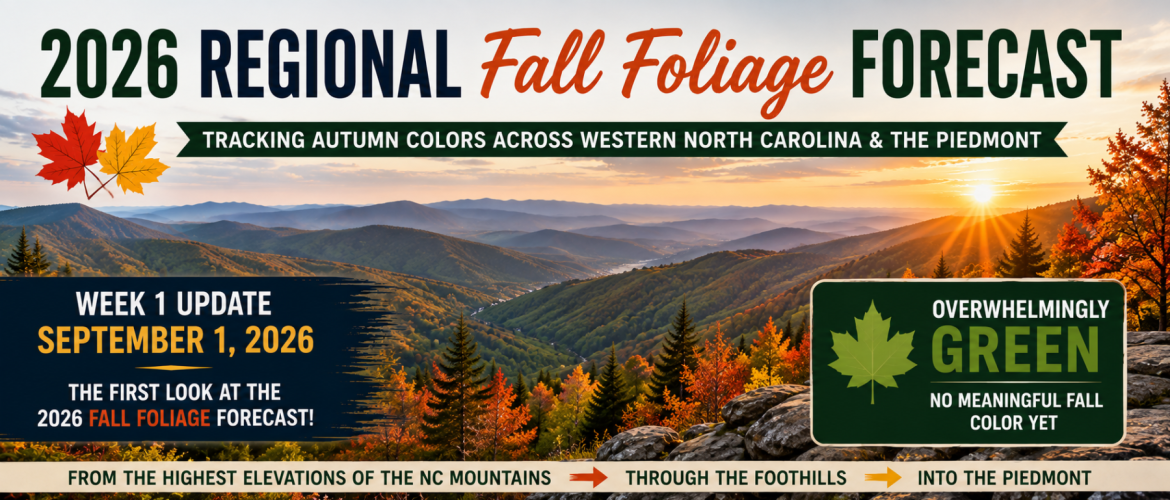
2026 Regional Fall Foliage Forecast: September 1
The 2026 fall foliage season is officially underway, and today marks the first Rowan County Weather Regional Fall Foliage Forecast of the season.
Each Tuesday throughout the fall, I'll track the progression of autumn color from the highest elevations of western North Carolina, through the foothills, and eventually into the Piedmont.
For our first update, the forecast is straightforward: the region remains overwhelmingly green.
September 1 Regional Outlook
Overall Status: GREEN — No Significant Change
From the highest elevations of western North Carolina through the foothills and across the Piedmont, there is no widespread seasonal color change to report yet.
That's exactly where we should be on September 1.
Even across the highest elevations, we're still early in the process. The National Park Service notes that scattered trees along the highest elevations of the Blue Ridge Parkway may begin showing some color in late September, with the more widespread transition typically developing during October.
That makes the mountains our first area to watch over the next several weeks.
Western North Carolina Mountains
Status: GREEN — No Significant Change
The highest elevations will eventually lead the transition, but I'm not ready to introduce the Early Change category this week.
An isolated tree may already show a hint of yellow or red. That doesn't necessarily mean the regional fall foliage transition has begun.
Some early yellowing, browning or leaf drop can also be associated with summer stress rather than the normal autumn color process.
For September 1, the mountain forecast remains green.
Foothills
Status: GREEN — No Significant Change
There is no meaningful seasonal color change expected across the foothills this week.
The weather during September will become increasingly important in determining how quickly the transition begins.
The start of September is expected to feature plenty of summerlike warmth. As we get deeper into the month, I'll be paying increasingly close attention to nighttime temperatures.
For now, the foothills remain solidly green.
Piedmont
Status: GREEN — No Significant Change
The Piedmont remains several weeks away from its typical fall color transition.
That includes the Charlotte region, Salisbury and surrounding areas, the Triad and much of central North Carolina.
You may occasionally notice an individual tree developing yellow or brown leaves or even dropping some leaves.
Don't automatically assume that's fall arriving early.
Drought and heat stress can cause trees to brown or shed leaves prematurely. That's different from the seasonal process that eventually produces widespread reds, oranges and yellows.
Drought Remains Part of the 2026 Story
One of the factors I'll be watching closely this year is drought.
North Carolina experienced significant heat and dry weather during portions of the summer before periods of heavier rainfall provided some relief.
While drought conditions have improved in some areas, moisture deficits remain in portions of the state.
That becomes important for fall foliage because trees that experience significant drought stress can sometimes brown or lose leaves before reaching their best autumn color.
Rainfall during September will therefore be one of the factors I use when evaluating the foliage forecast each week.
Nighttime Temperatures Become Increasingly Important
Cool nights are another major ingredient in the development of fall color.
As daylight continues decreasing through September, increasingly cool nights help set the stage for the breakdown of chlorophyll, the pigment responsible for the green appearance of leaves.
A pattern featuring sunny days and cool, but not freezing, nights can help produce vibrant fall color.
We're not there yet.
The beginning of September still looks and feels much more like summer across much of the region. What happens during the second half of the month will become increasingly important.
What I'm Watching This Week
Four factors will be especially important as we begin the 2026 foliage season:
Rainfall and drought conditions: Continued moisture will help determine how much drought stress trees experience heading into autumn.
Nighttime temperatures: I'll be watching for increasingly cool nights, particularly across the higher elevations.
The highest elevations: These should provide our first meaningful indication that the seasonal transition is beginning.
The September weather pattern: Extended heat could slow the initial transition, while cooler periods later this month could begin accelerating the process.
September 1 Fall Foliage Forecast
For Week 1, every part of the regional forecast remains in the same category:
Western North Carolina Mountains: GREEN — No Significant Change
Foothills: GREEN — No Significant Change
Triad and Northwest Piedmont: GREEN — No Significant Change
Central Piedmont: GREEN — No Significant Change
Charlotte Metro and Southern Piedmont: GREEN — No Significant Change
No portion of the regional forecast moves into the Early Change category this week.
That gives us our baseline.
As September progresses, we'll watch for the first signs of genuine seasonal color at the highest elevations. Once that begins, we'll follow the transition downhill through western North Carolina and eventually eastward into the Piedmont.
The Rowan County Weather Regional Fall Foliage Forecast will be updated every Tuesday throughout the 2026 fall color season.
Next Update: Tuesday, September 8, 2026.