Hurricane Melissa Update – Wednesday Morning
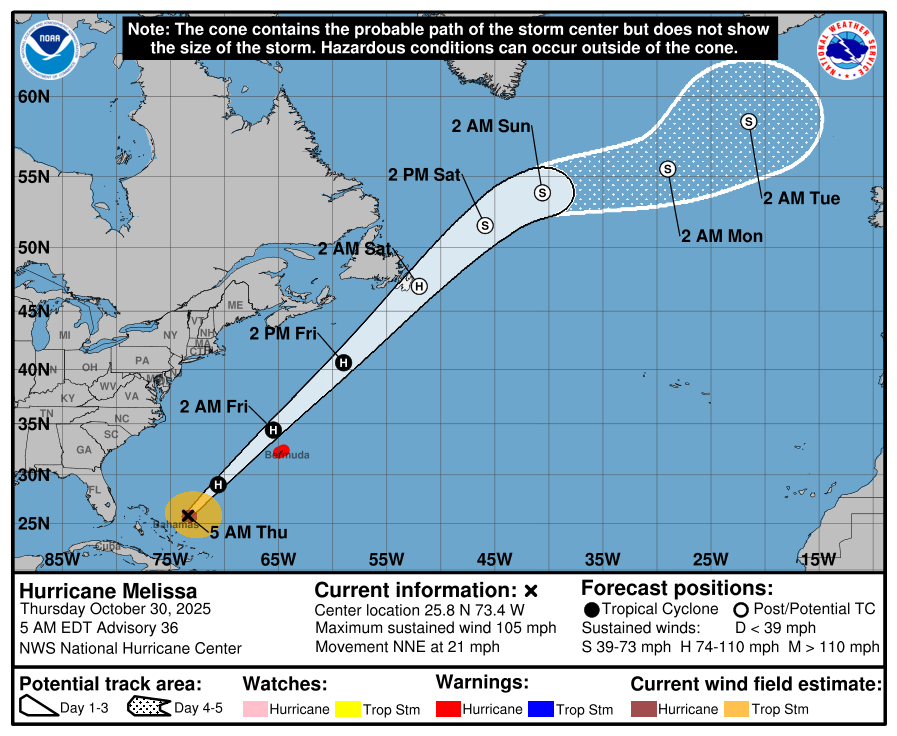
Melissa appears slightly better organized this morning. Overnight microwave satellite data revealed a closed mid-level eyewall, and recent visible imagery has shown hints of a ragged eye surrounded by deep convection near the center. Based on these observations, the National Hurricane Center has increased Melissa’s intensity to 90 knots (105 mph), supported by a 5.0 Dvorak classification from SAB.
Comparisons of microwave scans indicate that the storm’s vortex is tilted northeast with height, likely caused by southwesterly wind shear. An Air Force Reserve Hurricane Hunter aircraft is scheduled to investigate Melissa later this morning for a closer assessment of its structure and strength.
Melissa is moving quickly northeast at 18 mph (030°), pulling away from the Bahamas and tracking toward Bermuda. The latest forecast calls for an even faster northeastward motion during the next couple of days as the hurricane moves between a mid-level trough over the southeastern U.S. and a subtropical ridge over the central Atlantic. Forecast models remain tightly clustered, showing Melissa passing northwest of Bermuda tonight, where a Hurricane Warning remains in effect.
By late Friday, Melissa is expected to pass near the southeastern tip of Newfoundland before becoming a powerful post-tropical cyclone over the North Atlantic this weekend.
Forecast Summary:
-
Intensity: 90 kt (105 mph) – Category 2 hurricane
-
Movement: Northeast at 18 mph
-
Near-Term Impacts: Hurricane conditions expected in Bermuda tonight
-
Transition: Expected to become post-tropical Friday night or early Saturday
Key Messages:
-
Bermuda: Hurricane conditions are expected tonight, with tropical storm conditions developing later today. Residents should complete all preparations immediately.
-
Post-Storm Safety: Follow local official guidance. Flooding continues across parts of Cuba, Jamaica, and Hispaniola and may persist for several days. Ensure all generators are properly ventilated and placed outside at least 20 feet from homes to avoid carbon monoxide poisoning. Use caution with chainsaws and power tools during cleanup, and stay hydrated to prevent heat-related illness.
Melissa will remain a significant system over the open Atlantic as it transitions to a strong extratropical cyclone by the weekend.