
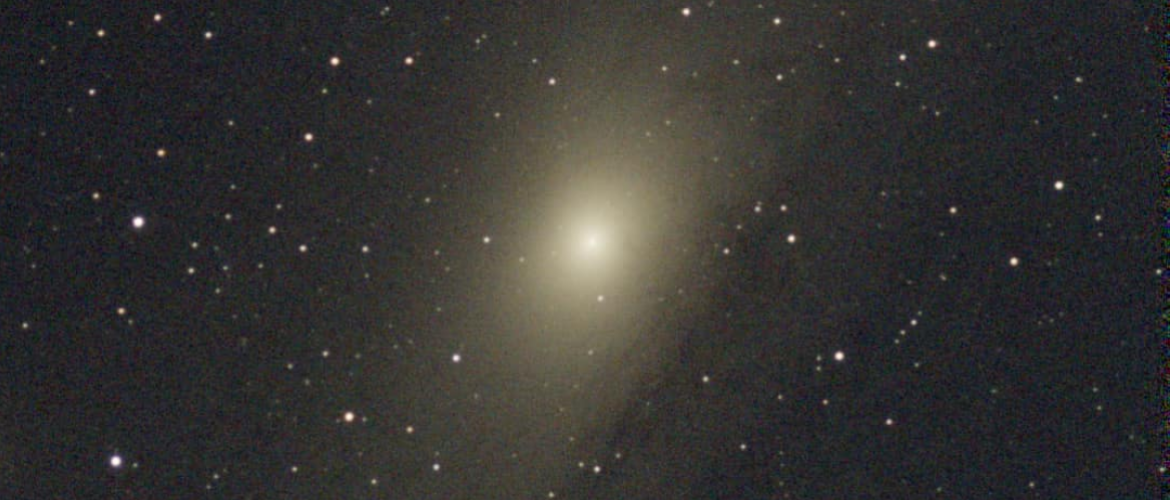
The Andromeda Nebula
One of the nebulas I have been able to photograph in the month of February is the Andromeda Nebula. I know there are some who may not know much about the Andromeda nebula, so I wanted to take a moment today to give you some history.
The Andromeda Nebula, more commonly known today as the Andromeda Galaxy (or M31 in the Messier catalog), is a significant celestial object in the night sky. Here are some key points about it:
Basic Information:
-
Type: It is a spiral galaxy similar to our Milky Way but larger.
-
Location: It's located in the constellation Andromeda, hence its name.
-
Distance: Approximately 2.5 million light-years from Earth, making it the closest major galaxy to our own.
Characteristics:
-
Size: The diameter of the Andromeda Galaxy is about 220,000 light-years, making it the largest member of the Local Group of galaxies, which also includes the Milky Way.
-
Structure: It has a prominent central bulge and multiple well-defined arms where star formation is active.
Historical Context:
-
Discovery: Although known to ancient astronomers, it was first described in the Western world by Persian astronomer Al-Sufi in his Book of Fixed Stars in 964 AD.
-
Naming: It was originally referred to as the Andromeda Nebula because its true nature as a galaxy was not understood until the 20th century. Edwin Hubble determined in the 1920s that M31 was indeed a separate galaxy, not part of the Milky Way.
Scientific Interest:
-
Star Count: It contains about one trillion stars, significantly more than the Milky Way's estimated 100 to 400 billion.
-
Black Hole: At its center, there's a supermassive black hole with a mass of approximately 140 million solar masses.
-
Future Collision: The Andromeda Galaxy is moving towards our Milky Way, and astronomers predict that in about 4 billion years, these two galaxies will collide and merge to form a new, larger galaxy, often referred to as "Milkomeda."
Observation:
-
Visibility: With the naked eye, it appears as a faint, fuzzy patch of light under dark skies. Binoculars or small telescopes make its shape more apparent, showing its elliptical form with a bright core.
Cultural Impact:
-
The Andromeda Galaxy has inspired numerous science fiction narratives, often serving as a backdrop for interstellar travel or alien civilization stories.
supermassive black holes
Triangulum Galaxy