The days are getting shorter
As we start to wind down the summer months, we also start to see the days get shorter. As the days get shorter the highs get lower and the nights get longer. to explain why the days get shorter in the winter and longer in the summer, first consider the two ways the Earth is rotating all the time.
The Earth spins around its axis, or the imaginary line running through the North and South poles, every 24 hours so that part of the planet is always facing the sun (experiencing daytime) while the opposite side of the planet is not (experiencing nighttime). Meanwhile, the Earth is also orbiting the sun, completing its circle every 365 days.
If the Earth's axis was straight up and down at 90 degrees, the length of time spent facing the sun would always equal the length of time facing away. But it isn't.
Instead, the Earth is tilted slightly at 23.5 degrees to be exact. Additionally, this tilt is always pointed in the same direction in space, toward Polaris (the North Star), even as the planet travels in a circle around the sun. This means that throughout its yearly orbit, sometimes the Northern hemisphere is closer to the sun (summer) while sometimes it is farther away (winter).
Depending where you are on the planet, the difference in the length of day from season to season can be larger or smaller.
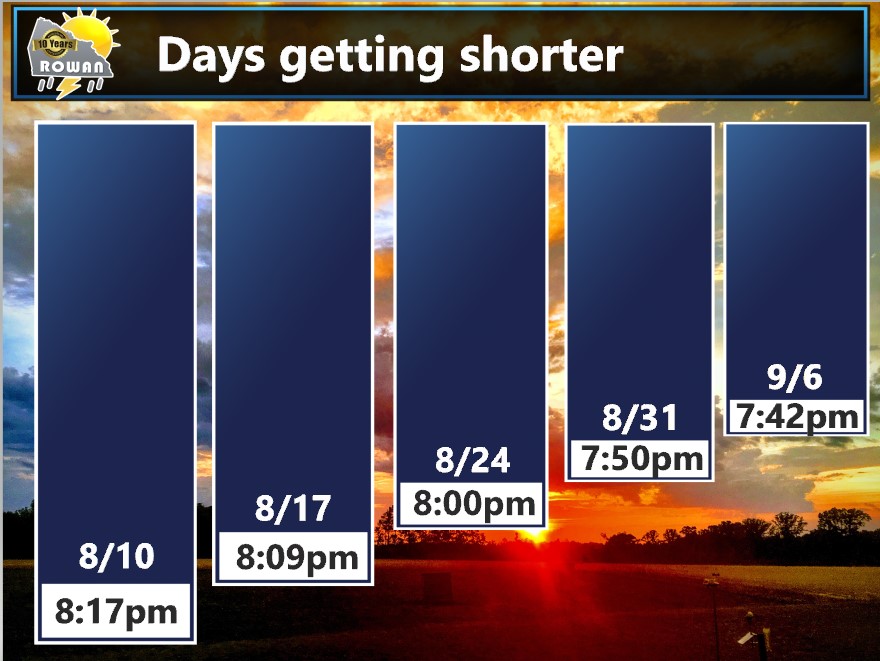
As we move through the rest of August and into early September, we will see our post 8pm sunsets come to an end by the first week of the meteorological calendar for the beginning of the fall season.
The graphic below shows how we will lose 35 minutes of daylight from tonight's sunset (8/10) to the sunset on September 6th. By the time we reach the winter solstice (the shortest day of the year) on Thursday December 17th, 2023, when the sunset will be at 5:12pm three hours and five minutes shorter than we are experiencing as of the time of this article.