
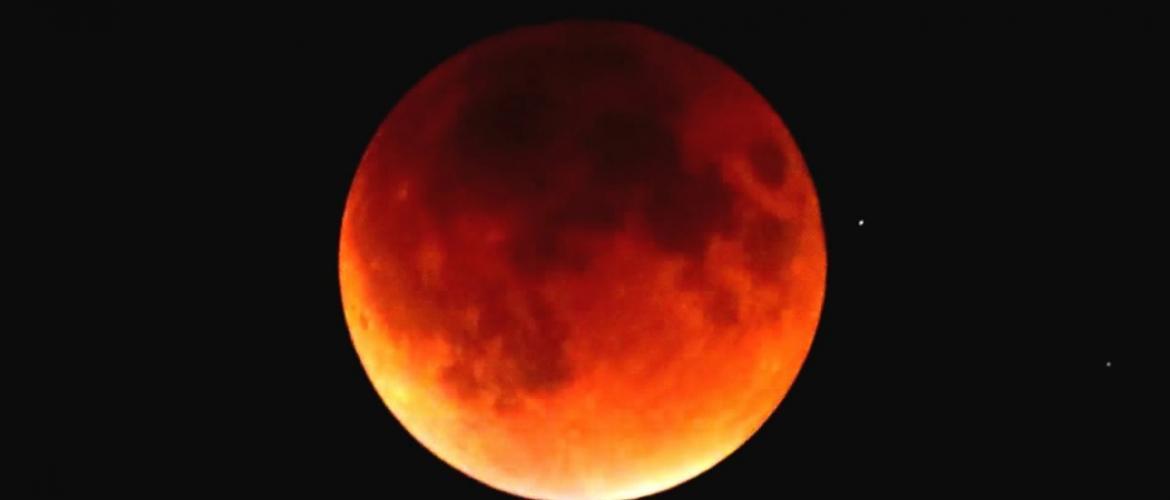
Super Blue Blood Moon’ Coming Jan. 31
What is it?
The full moon comes around like clockwork every 29 or so days—but each time is a little bit different. And in January, those differences will add up to a truly spectacular celestial event, a super blue blood moon, arriving on January 31. Let's pick apart that pile of adjectives to understand what's happening with this special moon, the coincidental alignment of three different types of moon cycles.
The designation "super moon" refers to what astronomers call a perigean full moon, one that occurs around when the moon is at perigee, the point in its orbit when it is closest to Earth. The super moon term itself has been in use since 1979, according to NASA, when it was coined by an astrologer, but it is met with mixed responses from astronomers.
With the boost from the moon's closeness, the satellite appears during a super moon phase just a smidge larger than it would at other times of the year. Precisely how much larger depends on how high the moon is in the sky and where it is in its orbit, but the super moon is never more than about 14 percent larger than any other moon.
The "blue" piece of the January 31's moon's title refers to a coincidence in how the lunar cycle aligns with our calendar. Because the moon waxes and wanes about every 29.5 days, typically there's only one full moon each month—but every so often, the cycles line up so that two full moons fit in the same calendar month, in which case the second is dubbed a blue moon.
That's what's happening this January, when the first full moon was on January 1 and the second, or blue, full moon falling on January 31.
And "blood moon" is simply a gruesome nickname for what's actually a lunar eclipse, when the Earth happens to align precisely between the sun and the moon. That casts Earth's shadow on the moon (the same way the solar eclipse in August cast the moon's shadow on the Earth), dyeing the satellite a reddish tinge.
Lunar eclipses can only occur during a full moon, but they don't occur every single full moon, since the Earth's orbit around the sun and the moon's orbit around Earth have little wobbles in them that sometimes prevent a perfect alignment.
And add a perigean moon and a quirk of our calendar system to a lunar eclipse and you get a full moon that's truly something special.
Can we see it in Rowan County?
Unfortunately, eclipse viewing will be more challenging in the Eastern time zone. The eclipse begins at 5:51 AM ET, as the Moon is about to set in the western sky, and the sky is getting lighter in the east.”
So in other words it won’t be all that noticeable. The darker part of Earth’s shadow will begin to blanket part of the Moon with a reddish tint at 6:48 a.m. EST, but the Moon will set less than a half-hour later. So your best opportunity if you live in the East is to head outside about 6:45 a.m. and get to a high place to watch the start of the eclipse—make sure you have a clear line of sight to the horizon in the west-northwest, opposite from where the Sun will rise
If you miss the Jan. 31 lunar eclipse, you’ll have to wait almost another year for the next opportunity in North America. The Jan. 21, 2019 lunar eclipse will be visible throughout all of the U.S. and will be a supermoon, though it won’t be a blue moon.