
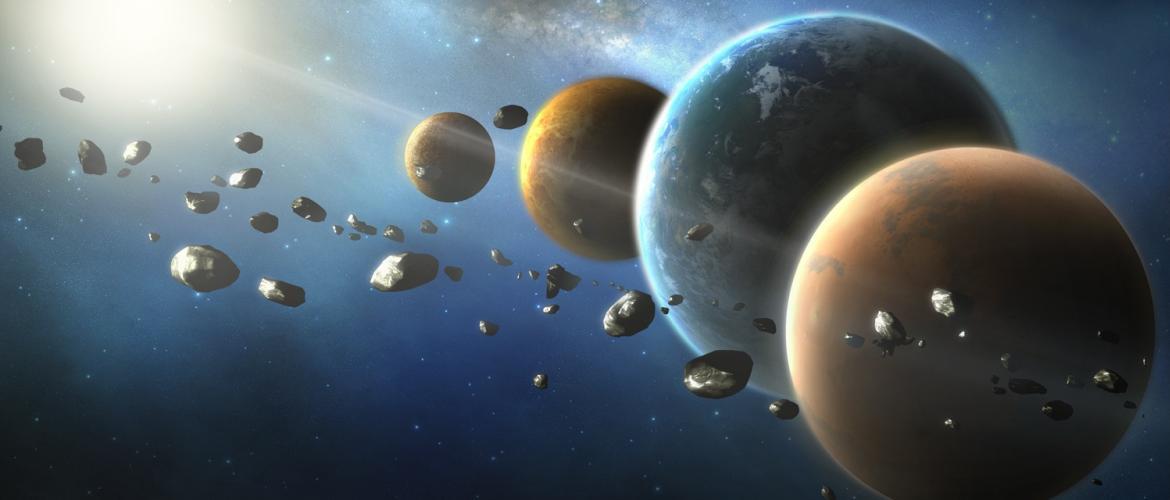
NASA discovers 7 planets that 'could have liquid water"
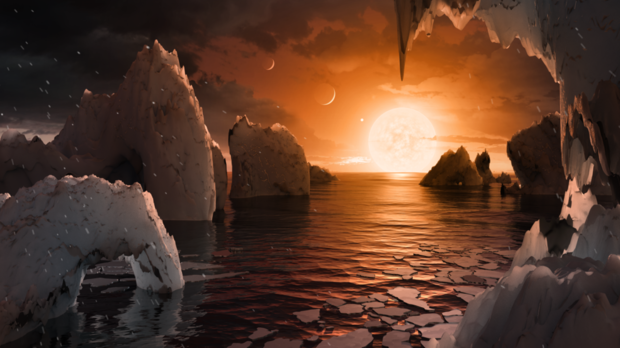
This illustration shows the possible surface of TRAPPIST-1f, one of the newly discovered planets in the TRAPPIST-1 system. Scientists using the Spitzer Space Telescope and ground-based telescopes have discovered that there are seven Earth-size planets in the system.(NASA/JPL-Caltech)
NASA on Wednesday, Feb. 21 announced the discovery of seven new planets that "could have liquid water -- key to life as we know it -- under the right atmospheric conditions.".
The Spitzer Space Telescope found seven Earth-sized planets around a single star, which sets a new NASA discovery record for the largest solar system around a single star.
NASA reports in a news release that while all seven planets could have water, there are three in the habitable zone which includes a rocky planet that "is most likely to have liquid water."
"This discovery could be a significant piece in the puzzle of finding habitable environments, places that are conducive to life," Thomas Zurbuchen, associate administrator of the agency's Science Mission Directorate, said in the release.
"Answering the question 'are we alone' is a top science priority and finding so many planets like these for the first time in the habitable zone is a remarkable step forward toward that goal."
The solar system -- TRAPPIST-1 -- is 40 light-years from Earth, which amounts to 235 trillion miles. Since the planets are outside of Earth's solar system, NASA labels them as exoplanets.
All planets in the new system are likely to be rocky on the surface, which means more observation and attention could "not only help determine whether they are rich in water, but also possibly reveal whether any could have liquid water on their surfaces."
The seventh and furthest from the single-star exoplanet has not been measured in mass yet, but NASA reports it could be an icy, snowball-like world.
"This is the most exciting result I have seen in the 14 years of Spitzer operations," Sean Carey, manager of NASA's Spitzer Science Center, said in the release. "Spitzer will follow up in the fall to further refine our understanding of these planets so that the James Webb Space Telescope can follow up. More observations of the system are sure to reveal more secrets."
NASA adds that the Spitzer, Hubble and Kepler will continue to conduct follow-up studies. The space administration's James Webb Space Telescope will launch in 2018, which will be able to "detect the chemical fingerprints of water, methane, oxygen, ozone, and other components of a planet's atmosphere."